When your furnace in Dublin, CA stops blowing warm air on a cold Tri-Valley night, checking the pilot light is usually the fastest way to find the problem. Most pilot light issues take less than ten minutes to diagnose with a flashlight and a little patience. Here's exactly how to check it, relight it safely, and know when the issue points to something bigger than a dead flame.
Quick Answer: Checking a Furnace Pilot Light
If you just need the short version, here it is:
- Turn the furnace off at the switch and turn the thermostat down.
- Remove the lower access panel to expose the burner compartment.
- Look for the pilot assembly and check for a flame.
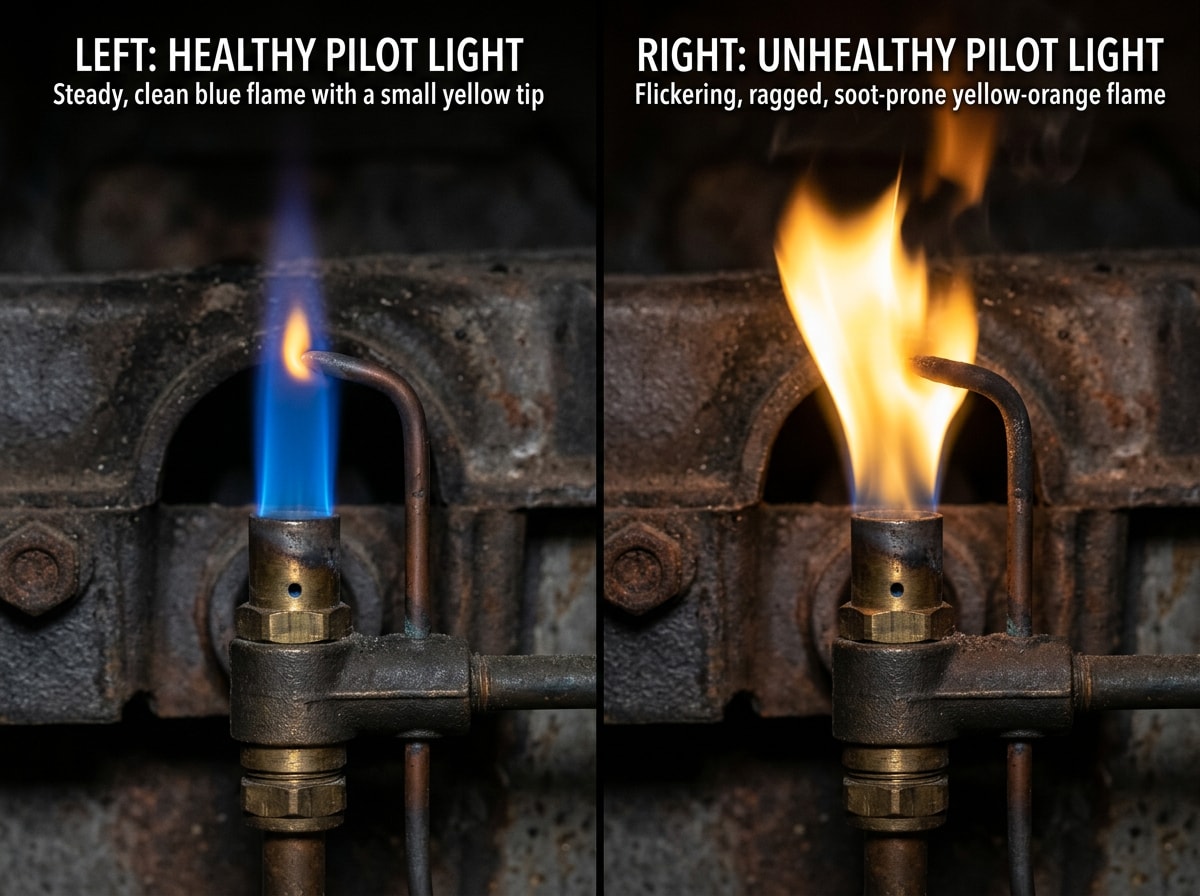
- A healthy flame is mostly blue with a small yellow tip; yellow, orange, or no flame at all means a problem.
- If it's out, turn the gas valve off, wait five minutes, then follow the manufacturer's relight instructions.
The rest of this guide walks through each of those steps in more detail, plus what to do if the pilot won't stay lit.
Do You Even Have a Standing Pilot Light?
Not every furnace has a pilot light to check. Furnaces built with electronic ignition use a hot surface igniter or spark ignition instead of a continuously burning flame, so there's nothing to inspect visually in the same way.
You likely have a standing pilot if your furnace is older or has a control knob marked Off/Pilot/On. If your unit has none of those and no small flame anywhere in the burner compartment, it's running electronic ignition and a no-heat problem points to a different cause, such as the igniter, flame sensor, or control board. If that's your situation, skip ahead to the professional-help section below, since relighting steps won't apply.
Tools You'll Need
Gather these before opening the furnace cabinet:
- A flashlight, for seeing into the dim burner compartment
- A long lighter or long fireplace match, for relighting without burning your fingers
- A screwdriver, in case the access panel is held on with screws
- Your furnace's owner's manual or the instruction sticker inside the panel, if available
Not every furnace needs all four. Many newer panels simply lift or slide off by hand.
Step-by-Step: How to Check Your Furnace's Pilot Light
These steps apply to older standing-pilot furnaces, not electronic-ignition systems.
1. Turn Off the Furnace and Take Basic Safety Precautions
Switch the furnace off at its power switch and turn the thermostat down so the system doesn't call for heat while you're working inside the cabinet. Clear the area of paint cans, cleaning supplies, or anything flammable, and make sure you have decent ventilation.
If you smell gas at any point, stop immediately, leave the area, and call your gas utility from outside. Don't flip any switches on your way out, since even a small spark near a leak is a real risk.
2. Locate the Access Panel
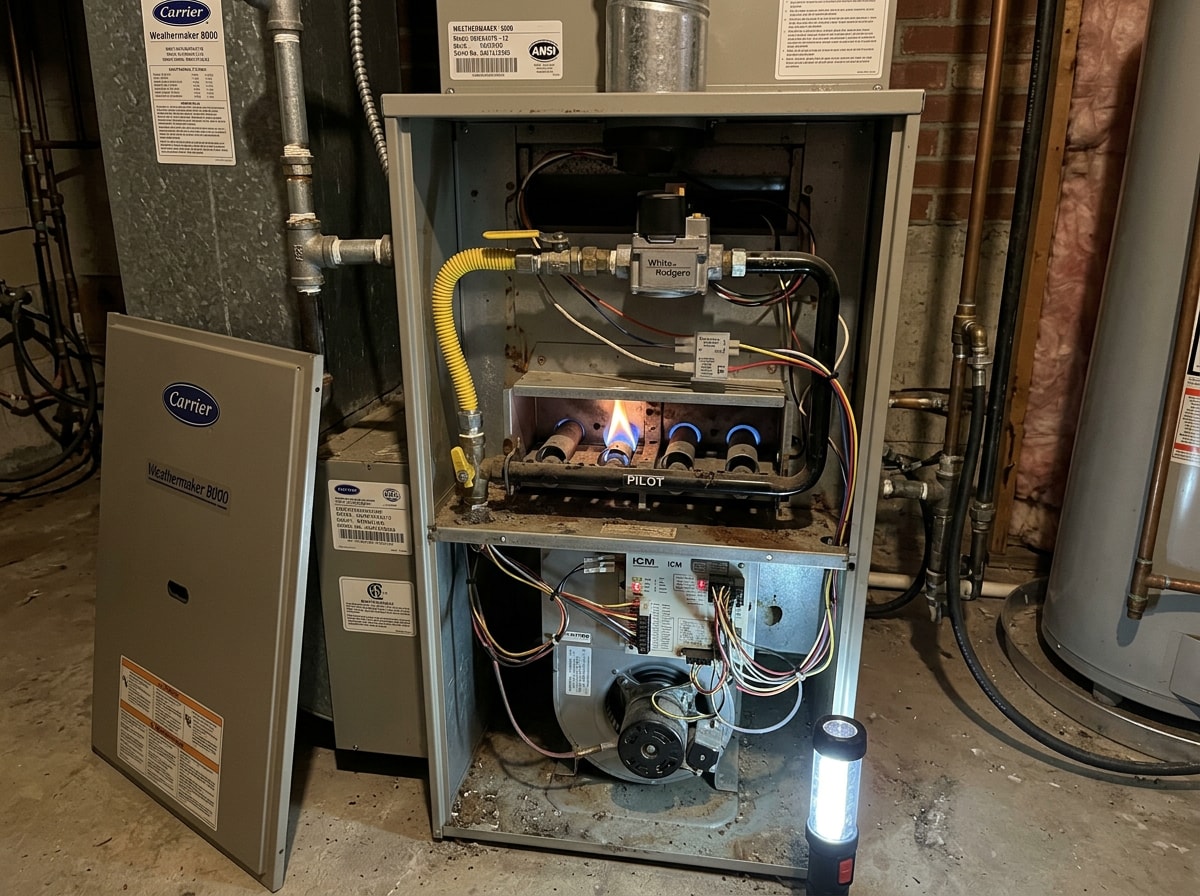
Most furnace pilot lights sit near the bottom of the unit, behind a removable panel covering the burner compartment. Depending on the model, it either pulls straight off or lifts away after you remove a couple of small screws or release a latch. Some cabinets have a small viewing window instead, letting you check the flame without removing anything.
3. Identify the Pilot Assembly
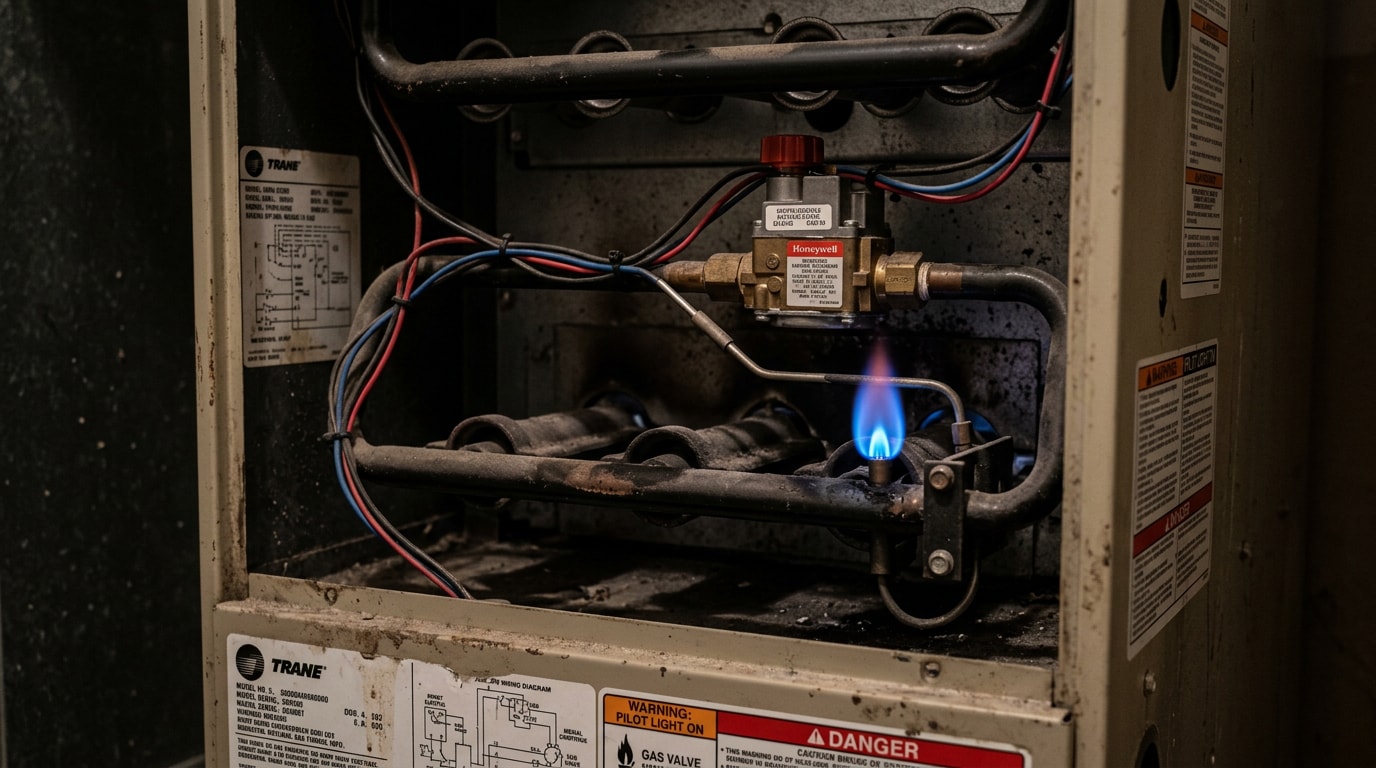
Once the panel is off, look for three things: the thin gas supply tube, the pilot burner tip, and the thermocouple or flame sensor sitting just above the flame. A flashlight helps a lot in this narrow, dim space. Before inspecting further, brush away any visible dust or cobwebs around the assembly. Debris buildup is one of the most common reasons a pilot struggles to stay lit.
4. Check the Flame Color
A healthy pilot light burns a steady, mostly blue flame with a small yellow tip, which signals clean, complete combustion. Trane's own troubleshooting guidance is blunt about this: if the flame is yellow, you should call for furnace repair.
| Flame Appearance | What It Means | What To Do |
|---|---|---|
| Blue and steady | Normal, healthy combustion | No action needed |
| Yellow, orange, or flickering | Dirt, poor air mixture, or a venting issue | Don't ignore it; incomplete combustion can produce carbon monoxide |
| No flame at all | Pilot has gone out | Move to the relighting steps below |
Carbon monoxide produced by incomplete combustion is dangerous precisely because you can't detect it with your senses. The CDC notes that carbon monoxide is an odorless, colorless, poisonous gas that can cause sudden illness and death if present in sufficient concentration , which is why a working CO detector near any gas appliance matters as much as checking the flame itself.
How to Relight a Furnace Pilot Light That's Gone Out
If you found no flame in step 3, here's the relight process most standing-pilot furnaces use:
- Turn the gas valve to OFF.
Wait at least 5 minutes for the gas to dissipate, for your safety, to avoid any flare-ups when you relight the pilot light. Don't skip this part.
Turn the knob to Pilot, then light a long lighter or long match and bring it close to the pilot light opening as you press and hold down the reset button (or the control knob itself, if there's no separate button).
- Keep holding for 30 to 60 seconds after it lights. This gives the thermocouple time to heat up and keep gas flowing to the pilot.
- Release the button and watch the flame for a minute or two. It should stay lit on its own, burning steady blue.
- Once you're confident it's holding, turn the control knob to On and restore power to the furnace.
If the pilot won't stay lit after a couple of tries, or the flame looks wrong once it's burning, turn the gas control back to OFF and stop. Repeated relighting without fixing the underlying cause is where people get hurt. In our service calls across Dublin and the greater Tri-Valley, we see a dirty or misaligned pilot orifice cause more "it won't stay lit" calls than an actually failed thermocouple, but you can't always tell which one it is from the outside.
Common Signs Your Pilot Light Needs Checking
In Dublin and the surrounding East Bay, these issues tend to surface most in fall and early winter, when furnaces fire up for the first time after sitting idle for months. Watch for:
- The furnace won't start, or blows cold air
- The burner makes noise but produces no heat
- A faint gas odor near the unit
- The system short-cycles without warming the house
If a furnace-not-heating problem doesn't resolve with basic troubleshooting, it's worth having it looked at rather than repeating the relight attempt. Our furnace repair team can usually diagnose a pilot or ignition problem in a single visit.
When Pilot Trouble Means It's Time to Replace, Not Repair
A pilot that keeps going out isn't automatically a sign of a dying furnace, but repeated failures on an older unit are worth a second look. Government efficiency data put this in perspective: a 90% AFUE furnace can run about $38 less per year in energy costs than an 80% AFUE furnace in a comparable climate region , and most furnaces with standing pilots fall well below that 90% mark. If your furnace is old enough to still use a standing pilot and the failures are becoming routine, it may be cheaper long-term to replace it than to keep nursing it along. Homeowners further down the Peninsula have faced this exact decision, as covered in our guide on furnace replacements in Los Altos.
If replacement looks like the better option, our furnace replacement and furnace installation pages walk through what's involved.
When to Call a Professional About Your Pilot Light
Some jobs are better left to a licensed technician:
- Cleaning a dirty pilot assembly and burner
- Replacing a worn thermocouple or flame sensor
- Inspecting the gas valve, ignition system, or venting for underlying problems
- Diagnosing an electronic-ignition furnace that won't fire
These repairs often require specialized tools and carry real safety risk if done incorrectly. If relighting doesn't resolve the issue, or you're simply not comfortable working near gas lines, it's reasonable to call in help rather than keep troubleshooting alone. If the furnace quits overnight or on a weekend, our emergency HVAC repair line covers after-hours calls.
If you're in Dublin, our local service team can handle a pilot light inspection, a full furnace tune-up, or a same-day repair. You can also visit our homepage to see the full range of heating and cooling services we offer across the Tri-Valley, or get a free estimate if you'd rather have a technician confirm the diagnosis in person.
FAQ
Is it safe to relight the pilot light myself?
Yes, generally. Relighting a pilot light yourself is safe if you follow the manufacturer's instructions closely and wait the full five minutes for gas to clear before relighting. The exception: if you smell gas, stop immediately and call your gas utility instead of continuing a DIY fix.
What color should my furnace pilot light be?
Mostly blue and steady, with maybe a small yellow tip. A large yellow or orange flame points to a combustion or ventilation problem that needs professional review, not a DIY fix.
Is it dangerous if my pilot light is out?
Not usually, on its own. The thermocouple shuts off gas flow when it senses no flame, which is a built-in safety feature. Repeated relighting without fixing the underlying cause is what turns a minor inconvenience into a real risk.
How often should I check my furnace pilot light?
At least once per heating season, ideally before the first cold snap, and anytime you notice unusual heating issues.
What does it mean if my furnace pilot light keeps going out?
Usually a dirty or faulty thermocouple, a clogged or misaligned pilot orifice, or a gas pressure issue. A draft near the furnace can also blow a weak pilot flame out. If it happens repeatedly, have a professional take a closer look rather than relighting it over and over.
Do I have a standing pilot light or electronic ignition?
Check for a control knob marked Off/Pilot/On, or look inside the burner compartment for a small continuous flame. If you see neither, and the furnace instead has a thin ceramic igniter strip or a spark electrode, it's electronic ignition, and there's no pilot to check or relight.
Can I use a regular lighter to relight the pilot?
Use a long lighter or long match, not a standard disposable lighter. The pilot opening sits deep inside the burner compartment, and a short lighter puts your hand too close to the flame path.